
Thesis
Voice of the Ocean
At-A-Glance
Voice of the Ocean is an animal-centered interactive design project that uses a hydrophone to capture underwater sounds from marine life and translates them into real-time visualisations through TouchDesigner. The goal is to give marine animals a “voice,” making their presence and struggles against plastic pollution visible and emotionally resonant for human audiences.
By transforming raw hydrophone data into an evocative experience, the project raises awareness of plastic waste and inspires communities to engage with marine conservation.
Solo Project
Bachelor of Design (Honours) Thesis
My Role
User research, UX/UI design, prototyping, TouchDesigner, branding, visual communication
Timeline
2020

Tools
TouchDesigner, Adobe Illustrator
Starting thoughts....
Plastic pollution silences marine life
Oceans are overrun with waste, and while the effects on marine animals are devastating, they often go unnoticed by local communities. Traditional awareness campaigns focus on human-centered narratives but what if the ocean itself could speak?
The Solution
Give the ocean a
voice through design
I created an installation that transforms underwater sounds, captured by a hydrophone, into dynamic visualisations using TouchDesigner. By turning marine life activity into a living artwork, the design lets audiences experience the ocean’s voice firsthand, evoking empathy and raising awareness of plastic pollution.

01. Discover
Framing the Problem
The starting point for Voice of the Ocean was the urgent issue of plastic pollution and its devastating impact on marine ecosystems. Reports of trillions of plastic pieces in the ocean highlighted how this global crisis filters down into local shorelines. Yet despite the scale of the issue, it is often invisible in everyday life. My aim in this stage was to uncover the problem in a way that felt immediate and personal rather than abstract.
Ethnographic Research
To ground the project in real experience I carried out ethnographic research at my local foreshore. Over a week I visited the site daily and documented what I saw through photography and note-taking. At first glance the beach appeared clean but closer inspection revealed plastics scattered along the tide line. Even when I collected waste one day, more had returned the next.
This cycle revealed two insights. First, the persistence of pollution is not obvious to casual visitors who quickly overlook it. Second, the problem is not isolated but constant, a repeating pattern that reflects larger systemic issues. Recording these observations in a visual journal allowed me to capture how plastic infiltrated the environment and how people ignored its presence.


Reviewing Existing Solutions
Alongside field research I explored current projects that address ocean plastic and sustainability. Campaigns such as 4Ocean’s recycled bracelets, large-scale efforts like The Ocean Clean-up, and evocative artworks such as The Cry of the Dead Whale demonstrate the range of strategies already being used. These initiatives raise awareness or create products but few directly translate the voices of marine life into human experience.
This review highlighted a clear gap: most solutions speak about marine life rather than letting the animals be heard themselves. The opportunity for Voice of the Ocean was to create an animal-centred interaction where hydrophone recordings become both a medium for awareness and an emotional bridge between species.


Insights
-
Plastic pollution is continuous and often invisible in everyday coastal life.
-
Communities connect deeply with shared spaces but overlook environmental threats within them.
-
A successful design must capture attention emotionally rather than rely only on facts or instructions.
These insights set the foundation for the next stage, where I turned toward empathising not only with the local community but also with the marine life that cannot speak for itself.
02. Empathise
Understanding Marine Life as Stakeholders
From the beginning I wanted the project to be animal centred. The challenge was not just to represent marine life but to create a way for them to participate in the interaction. Through research I learned how mammals like whales and dolphins use echolocation, and how other species produce unique underwater sounds. These sounds are often masked by pollution and boat noise, but they remain the most authentic expression of ocean life.
The hydrophone offered a safe and non-invasive way to capture these voices. Unlike speculative or anthropomorphic designs, the hydrophone allowed me to ground the project in real data directly from marine life. This meant the design could act as a platform rather than a translation, giving animals space to be heard on their own terms.
Bridging the Two Perspectives
By listening to both marine and human voices I was able to refine the project direction. Marine life required a non-invasive method of participation, while communities needed a visceral and engaging experience that would make the unseen visible. The hydrophone and TouchDesigner visualisations became the bridge, transforming underwater sound into imagery that humans could connect with.
03. Ideate
Early Directions: Recycling and Artefacts
My first ideation phase focused on recycling as a way to address plastic pollution. Inspired by projects like Ecofin surfboard fins and 4Ocean wristbands, I explored how collected waste might be reformed into usable objects. Sketches included concepts such as surfboard accessories, jewellery, or community artefacts made from plastics gathered at local beaches.
While these ideas had potential to reduce waste, further research revealed a major limitation. Recycled plastics in marine environments can slowly release microplastics back into the water. This meant that even designs intended to be sustainable risked reintroducing the very problem they sought to solve. These insights encouraged me to move away from recycling into artefacts and towards ideas that could create awareness and empathy instead of products.
Shifting the Focus to Interaction
Recognising that products alone would not capture the urgency of the problem, I began ideating around interaction. What if the design could speak directly to people about the state of the ocean? What if marine life themselves could be involved?
This shift led me to sketch broader speculative ideas such as:
-
Wearable devices that picked up underwater activity and relayed it to the user
-
Backpacks and sleeves that generated soundscapes of marine life
-
Billboard-sized projections that visualised the health of local waters in public space
Arrival at the Hydrophone Concept
The turning point came with the discovery of the hydrophone. Unlike recycled products or speculative wearables, this technology allowed marine life to input directly into the design. It shifted the project from being about the animals to being with them. The hydrophone became the foundation for an animal-centred approach.
From here the ideation process moved toward imagining how sound data could be transformed into visual forms. This included holographic projections, screens, and eventually TouchDesigner-based visualisations. The focus became less about the material outcome and more about the experience of empathy, how to make the invisible voices of the ocean visible to humans.


04. Prototype
From Sketch to Physical Model
The first step in prototyping was translating sketches into something tangible. I built simple models of the wearable sleeve concept using household materials to explore scale and ergonomics. These low-fidelity prototypes helped me understand how the hydrophone, screen and audio outputs might sit on the body.
While these mockups were useful for testing practicality, they quickly revealed a limitation. The wearable design restricted the experience to one person at a time, which conflicted with my broader aim of creating collective awareness.


Exploring Installation Prototypes
With this realisation I shifted my focus toward prototypes that could work in public space. Two early experiments were:
-
Holographic projection tests — by reflecting light through simple structures I created illusions of three-dimensional visuals. While low-fidelity, these tests proved that data could be made spatial and immersive.
-
Interactive screens — I mocked up billboard-style displays that could sit at the foreshore, relaying live hydrophone data as visuals. This allowed multiple people to engage simultaneously and turned the design into a community artefact.
Coding Experiments
Parallel to physical tests I explored digital coding environments. Using P5.js I built early sketches of how underwater audio might be visualised. These tests gave me a basic understanding of data-to-visual pipelines but felt limited in depth and expressiveness.
Through user testing I learned that audiences wanted visuals that felt alive and fluid rather than abstract and technical. This feedback motivated me to search for a more capable tool.
Transition to TouchDesigner
The breakthrough came when I transitioned into TouchDesigner, a node-based visual programming platform. Here I could directly connect the hydrophone and build dynamic audio-responsive visuals.
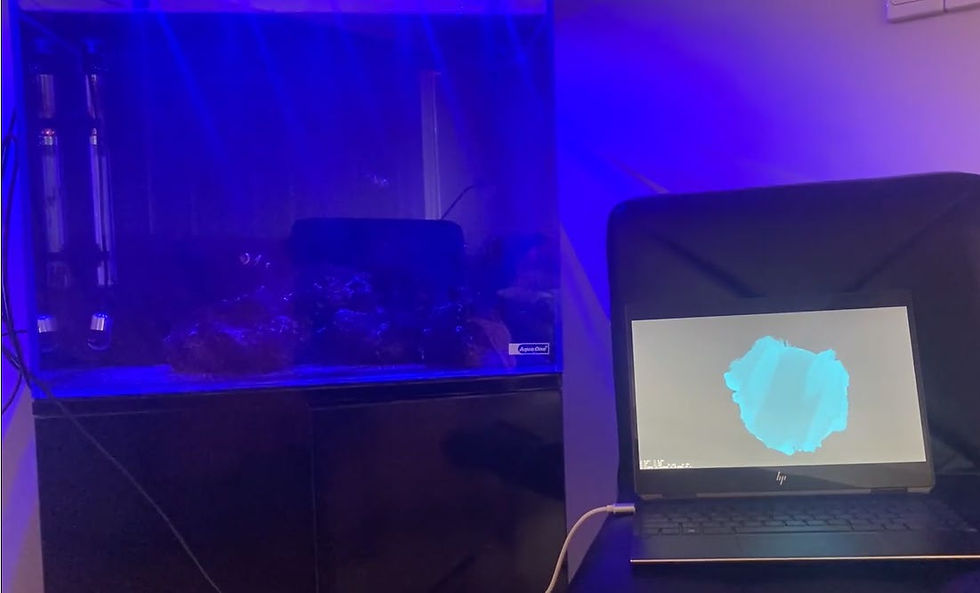
I began experimenting with spherical forms and water-like textures that responded in real time to marine sounds. The design resembled flowing currents or even a view of Earth from space. User feedback confirmed that these forms created a sense of depth and empathy, making people feel as though they were “seeing the ocean breathe.”


Testing with Humans and Marine Life
Prototypes were tested with human participants as well as marine life in controlled settings. The hydrophone captured distinct sounds from different species, each producing unique visualisations. This confirmed that the system could authentically represent animal voices without human input.
Human participants responded emotionally to the visuals, often describing them as cries for help or signs of life beneath the surface. These tests validated that the prototype was not only functional but also aligned with the project’s empathetic aims.
5. Reflection
Looking Back on the Process
The journey from initial discovery to the final iteration showed me how design can shift direction in response to insights and testing. I began with ideas about recycling plastics into new artefacts, yet through research I discovered that these solutions risked creating more harm through microplastics. This realisation encouraged me to rethink the problem not as one of product-making but of communication and empathy.
What Changed Along the Way
Several turning points shaped the project:
-
Ethnographic research showed me that pollution is often invisible in daily life and that communities do not always recognise its impact.
-
User feedback revealed that people respond more strongly to emotional connections than to abstract data or instructions.
-
Hydrophone testing confirmed that marine life could safely and authentically contribute their voices, which became the cornerstone of the design.
-
Transitioning to TouchDesigner unlocked the potential to create rich, responsive visuals that matched the project’s empathetic goals.